
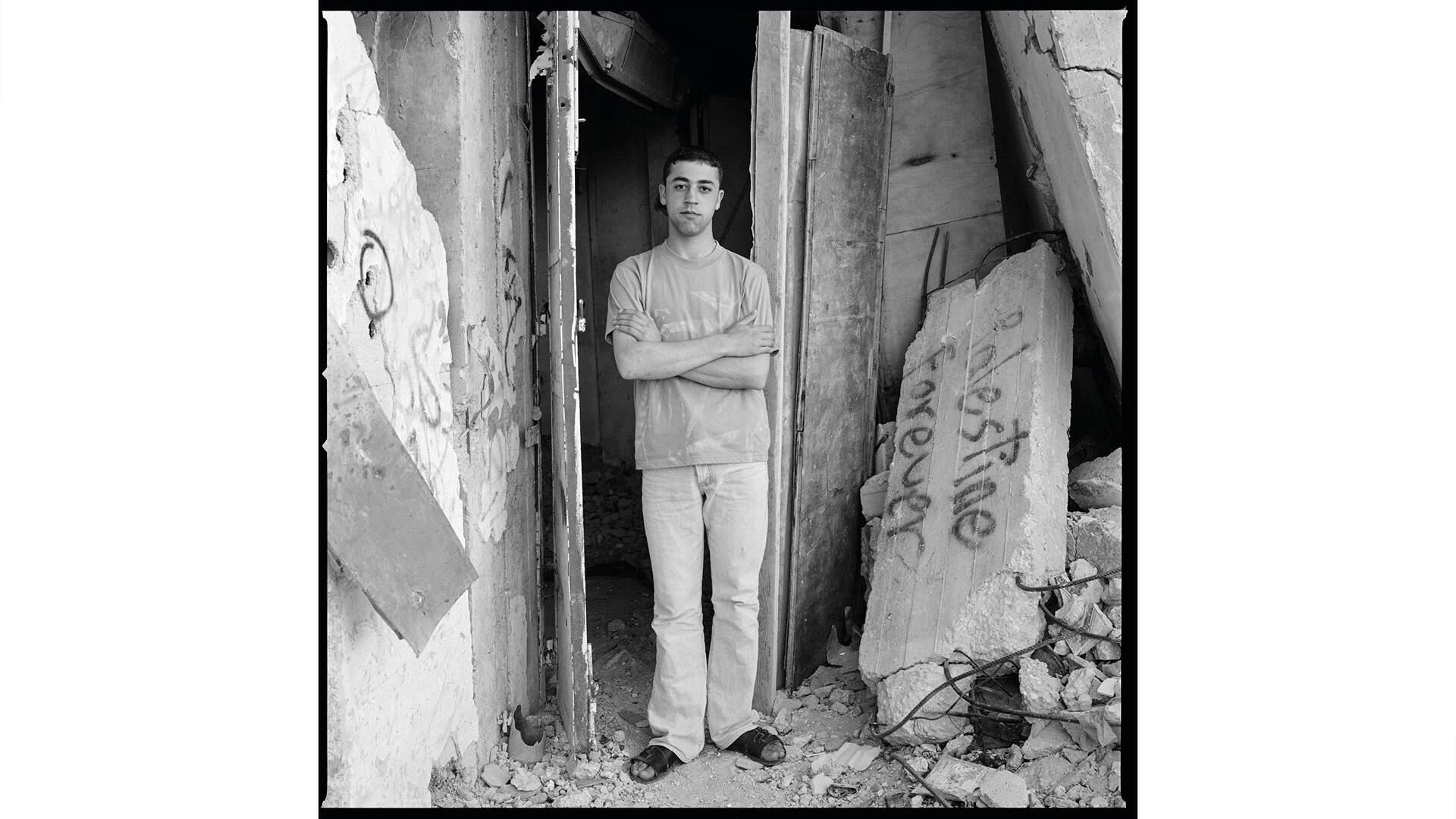
Alan Gignoux: "Homeland Lost"
Homeland Lost is an exhibition of an historic series of Palestinian photographs by award-winning documentary photographer Alan Gignoux. Homeland Lost juxtaposes portraits of Palestinian refugees displaced in 1948 and their descendants, shown alongside images of their former homes and villages inside Israel. Taken between 2004 and 2005, Homeland Lost is a poignant and sobering reminder of the human toll of an ongoing conflict which has displaced an estimated 8 million Palestinians and their descendants since 1948.
Originally sponsored by the British Council in East Jerusalem and toured from 2006, this is the first time works from Homeland Lost been shown in the UK since it was exhibited alongside the Palestine Film Festival at the Barbican in 2008. Homeland Lost at P21 is curated by Jenny Christensson who also curated the original touring exhibition. The series will be the subject of a new limited-edition book, publication TBA Spring 2027.
Working with a Hasselblad medium-format camera and black and white film, Gignoux photographed individuals and families living in refugee camps in Jordan, Lebanon, Gaza, and the West Bank. To each person he photographed, Gignoux made a clear and explicit pledge: that he would return to their former homes on their behalf and document what remained. He travelled across Israel to honour that commitment, photographing sites that still bore the traces — or the erasures — of the villages from which they were displaced in 1948. He returned as a witness in their stead, to a homeland they themselves were not permitted to visit, capturing firsthand accounts of the displaced and their descendants of the lasting trauma of losing homeland.
In bringing these images together, Homeland Lost underscores the historical reality behind the Palestinian experience. The meeting of portrait and landscape, together with the stories of displaced Palestinians, reunites people with the places from which they were separated and uses photography as a means of bearing witness to both absence and presence.
In 2026, following the destruction of some 90% of homes and infrastructure in Gaza, in addition to a state of war and instability throughout the region, Homeland Lost has acquired renewed significance as an archival record of displacement and its intergenerational consequences.
Migration, statelessness, and political accountability are some of the most pressing global concerns of our era. Homeland Lost offers a human-centred documentation of lives shaped by forced rupture and sustained by enduring ties to place. The portraits draw attention not only to what was lost, but to what has survived: memory, attachment, and the transmission of history across generations.
Palestinian voices
The original exhibition included testimonies from the people Alan photographed. These personal statements include Sylvia Ballan Sneige, photographed in Beirut, who was displaced from the family home in Jerusalem in 1948. She describes her experience of this pivotal moment:
“I was 11 years old, and my brother was 8 years old when we left… I remember that there were only hungry stray cats and dogs roaming the streets when I looked out the window praying that my father would finally come for us. When I was asked to pack my suitcase, I had the dilemma of what to take with me… summer clothes of course as it was already May…my schoolbooks...some treasured trinkets…but I had to leave behind brand new blue sandals on the windowsill of my bedroom…
My mother lived to be 84 and died peacefully in my arms. She gave me the keys of our house in Jerusalem before she died…She kept them all these years hoping to be able to return one day to Jerusalem. I still have them with me.”
Many Palestinians feel a duty to honour and preserve what has been lost and this ongoing story of displacement and rupture is passed on from each generation in stories and carefully treasured links to their former homeland. Homeland Lost includes a portrait of retired teacher, Mahmoud Dakwar (now deceased), together with keys from lost homes, which he collected forthe archive in his Museum of Palestinian Heritage in Lebanon. The museum was created by Mahmoud with his own money to give Palestinian schoolchildren a sense of their own history.
Mahmoud still remembered his own flight from Jerusalem at the age of 11 - on foot to Lebanon without his parents – as if it were yesterday. In his museum he tried to reconstruct something of the Palestine he left behind. Mahmoud stated, “We have a duty to remember this, always. It is our story.”
For the exhibition at P21 Gallery, Gignoux and Christensson have returned to many of the original participants of Homeland Lost and their families, to update some of the previous testimonies – 20 years on.
They asked Alan’s fixer in Gaza, journalist Safwat Al-Khalout, if he knew what had happened to the people photographed in Gaza all those years ago, long before the recent war. In response, Safwat wrote:
“The moment he sent the photographs, and I began to look at them, I was pulled twenty years back in time. Those images carried me to places that were once my shelter, my homeland, my home, my family, and my friends. I could not stop crying. I wept like a child who had lost everything, not only his favorite toy, but even his parents, and was left alone in the world.
Those photographs took me into a world that now feels almost unreal, even though it once was my real life. Even now, I still struggle to accept that what happened to us, as Palestinians in Gaza, is not a nightmare from which I will eventually wake, but a living reality that continues to unfold.”
During the exhibition P21 Gallery will host a series of events related to the work. Further information on events will be available at https://p21.gallery/ from 8 June.
NOTES TO EDITORS
Homeland Lost Photobook: Twenty years on, Homeland Lost has acquired renewed significance as an archival record of displacement and its intergenerational consequences, prompting Gignoux to make the work more widely available in the form of a limited-edition photobook. The book will expand the project’s scope, presenting the full archive of 177 portraits and 81 villages as a stand against erasure, alongside maps and a newly commissioned essay by a Palestinian writer. Intended as both an artistic undertaking and a significant historical resource, it will deliver an important visual narrativization of displacement. A Kickstarter campaign to support the self-publication of the photobook will launch in September 2026; there will be opportunities to pre-order from the start of the exhibition.
Alan Gignoux: Gignoux is an award-winning documentary photographer and founder of Gignouxphotos, which produces documentary photography projects focussing on socio-political and environmental issues around the world. Gignoux specializes in long form documentary projects that explore an issue and its impact on communities over long periods of several years; combining photography, video, interviews, research, and writing in creative and innovative ways to create layered projects offering multiple perspectives https://gignouxphotos.com/
Original Homeland Lost exhibition tour: Thanks to support from the A.M. Qattan Foundation, Homeland Lost originally toured to Al Ma’mal Centre for Contemporary Art (2006, Jerusalem), Bethlehem Peace Centre (2006), Jaffa Cultural Centre (2006, Nablus), Birzeit University (2006, Ramallah), Dar al Anda Gallery (2007, Amman), Masrah al Madina Theatre (2007, Beirut), Contemporary Image Collective (2007, Cairo) and the Alexandria Contemporary Arts Forum (2007). It was shown as a solo exhibition at The Linen Hall Library (Belfast, 2007), the Cinematheque (Tel Aviv, 2008) and the Linen Hall (Ypres, 2010) and included in group exhibitions at the Barbican (2008, London), the Tropenmuseum (2008, Amsterdam), and the University of Ghent (2011).
For further exhibition information, press images and interview opportunities, please contact: P21 Gallery, email: mail@p21.org.uk, Tel. 020 7121 6190, or Celia Bailey PR - 07930 442 411, bailey_celia@hotmail.com
Link to press Images: HERE